Large language models frequently present inaccurate information with compelling confidence, a phenomenon rooted in the fundamental nature of language rather than coding errors. This fluency in “lying” stems from their mathematical grounding, which prioritizes statistical coherence over factual truth. Understanding this distinction is crucial for developing trustworthy AI systems capable of reliable decision-making. This article will explore how a focus on mathematical principles can help expose and ultimately mitigate these deceptive tendencies.
The concept at the center of this phenomenon is called the honesty gap. Coined in a 2026 research paper by Daryl Ledyard and Philip Tyler, D.M., the honesty gap describes the distance between persuasive language and verified truth. In human communication, it shows up as euphemism, ethical fading, and motivated reasoning. In AI systems, it appears as hallucination, unsupported synthesis, and citation-shaped language without source custody. The worry is not merely that machines can be wrong. It is that machines can be wrong in fluent, reasonable, socially persuasive language.
This article traces the anatomy of the AI honesty gap why it exists, where it creates risk, and how mathematical grounding offers a structural antidote. It is written for practitioners and researchers who want to understand not just what AI systems do, but why fluency and accuracy so often come apart.
1. The Honesty Gap Defined: Where Persuasion Meets Unverified Truth
Before examining AI specifically, the term itself requires precision. The honesty gap is not simply "inaccuracy." Inaccuracy implies a gap between output and reality that can be measured and corrected. The honesty gap is more subtle: it is the gap between what a statement sounds like it means and what it can actually be held to. A sentence can be grammatically perfect, semantically coherent, and still carry no verified relationship to the evidence it implies.
Ledyard and Tyler's framework formalizes this distinction. In their definition, a claim is not merely a sentence. It is a tuple a structured set of elements that includes the statement itself, the domain it applies to, the truth condition, and the evidence requirement. Without those four elements, language remains expressive but under-bounded. It may point toward a reality without specifying the procedure by which that reality can be checked.
"The anxiety around artificial intelligence is not merely that machines can be wrong. It is that machines can be wrong in fluent, reasonable, socially persuasive language."
Daryl Ledyard and Philip Tyler, D.M., GenXis Research: The Honesty Gap: Words Vs. Math
This distinction matters because the honesty gap in AI is not primarily a technical failure. It is a linguistic inheritance. Language evolved to communicate under uncertainty, to socialize, to persuade, and to coordinate not to carry machine-grade certainty. When AI systems generate language, they inherit all of language's flexibility, including its capacity to sound precise while remaining logically incomplete.
2. Why Language Is Squishy: The Structural Vulnerability AI Inherited
The GenXis Research paper puts it plainly: "Language can preserve signal, but it can also metabolize error into something that sounds reasonable." Natural language is flexible by design. It allows approximation, metaphor, implication, emphasis, ambiguity, and context dependence. These features make language humanly useful. They also make it a weak carrier of verified certainty.
Consider a sentence like "the model is aligned" or "the evidence supports the claim." Each may be true, false, evasive, or meaningless depending on hidden definitions. What counts as aligned? Which model? What evidence? Which circumstances? The words feel precise. The underlying commitments are not.
Researchers and practitioners have developed informal vocabulary to describe this phenomenon. Terms like "vibes" and "slop" now circulate in technical discourse to describe language that feels meaningful while carrying weak constraint. The GenXis Research paper traces this dynamic to its roots in human psychology motivated reasoning, cognitive dissonance reduction, moral disengagement, euphemistic labeling, and ethical fading. AI systems, trained on human-generated text, inherit these patterns. They learn to generate language that sounds like it means something without being able to specify what it means or how to verify it.
Over time, small verbal deviations compound. The GenXis Research paper offers a useful analogy: it is like a singer drifting slightly off pitch until the tonal center is lost. The individual notes are still there. The music is still recognizable. But the relationship to the original key has dissolved.
3. Why Fluency Makes the Problem Worse: Confidence Without Grounding
The honesty gap becomes most dangerous when fluency is high and verification is absent. Public concern about AI has intensified precisely because language models now operate in domains where verbal mistakes have real consequences legal drafting, medical triage, education, scientific writing, financial reporting, security analysis, and software development.
The worry is not merely that systems hallucinate. The worry is that hallucinations arrive in the same polished form as true answers. A legal citation can be fabricated in perfect legal prose. A medical explanation can sound clinically plausible while omitting a contraindication. A financial summary can appear authoritative while relying on stale facts. In each case, the danger comes from the mismatch between linguistic confidence and verified grounding.
This dynamic has been observed across domains. In education reporting a parallel context where the honesty gap has been studied extensively the Fordham Institute's Dale Chu documented how lowered proficiency thresholds create a gap between what states report and what students actually demonstrate. "America is awash in achievement 'data,' yet the truth about our educational performance is far from transparent and trustworthy," wrote Finn and Petrilli in The Proficiency Illusion, which flagged these dangers more than fifteen years ago. The same structural pattern appears in AI: more output, less truth.
The parallel is instructive. In education, the honesty gap widened because political pressures incentivized optimistic reporting. In AI, the honesty gap widens because language model training optimizes for fluency, coherence, and user satisfaction not for verified correspondence with evidence. The incentive structure shapes the output.
4. Hallucination vs. Dishonesty: A Necessary Distinction
A key clarification in the GenXis Research framework separates hallucination from dishonesty. These are not the same thing, and conflating them obscures the solution.
Hallucination, in the AI context, refers to generated content that is not supported by the training data or retrieval sources but sounds confident and well-formed. It is a generation artifact the model producing text that is statistically plausible but factually unsupported. Hallucination is often unintentional. The model is doing what it was trained to do: produce fluent continuations of input patterns.
Dishonesty, by contrast, implies something closer to the human dynamic of motivated reasoning: language that drifts from evidence because of implicit pressures, social incentives, or the squishiness of verbal framing. An AI system can be dishonest not by fabricating facts but by selecting facts that support a predetermined conclusion, by framing ambiguity as certainty, or by omitting evidence that would complicate the narrative.
The distinction matters for remediation. Hallucination can be partially addressed through retrieval augmentation, fact-checking layers, and confidence calibration. Dishonesty requires something more fundamental: structural constraints on how language is generated, evaluated, and grounded. The GenXis Research paper identifies mathematical constraint as the core mechanism for addressing both not because mathematics is immune to interpretation, but because it provides deterministic checks that pure language processing cannot supply.
5. Where the Gap Hurts Most: High-Stakes Domains and Consequential Decisions
The honesty gap is not equally dangerous across all applications. It is most consequential in domains where decisions based on false information carry real costs.
Legal drafting is one of the clearest examples. When an AI system generates a brief, contract clause, or case citation, the prose can be indistinguishable from attorney-written text. But if the citation does not exist, the legal argument collapses and the user who relied on it may face serious consequences. The fluency of the output masks the absence of verification.
Medical triage presents similar risks. A system that generates clinical explanations in authoritative language may omit contraindications, misrepresent drug interactions, or fail to flag urgent symptoms. The patient or clinician receives what sounds like a professional assessment. Whether it reflects current medical evidence is not always visible in the text.
Financial reporting and security analysis share the same structural vulnerability. Authoritative summaries can appear well-sourced while relying on stale data, missing recent developments, or omitting relevant context. The user evaluates the output based on its surface quality its fluency, its structure, its apparent comprehensiveness not on the underlying evidence chain.
In each of these domains, the GenXis Research paper argues that the central question must be: when does a sentence become a verified claim? The answer requires moving beyond language alone and building verification infrastructure into the generation process.
6. Mathematical Grounding: The Antidote the GenXis Framework Proposes
The GenXis Research paper does not argue for less language. It argues for stronger grounding. Specifically, it proposes that mathematical constraint deterministic checks, formal verification, calibrated abstention, and evidence memory provides the structural antidote to the honesty gap.
"The antidote is not less language, but stronger grounding: mathematical constraint, source custody, deterministic checks, calibrated abstention, and evidence memory."
Daryl Ledyard and Philip Tyler, D.M., GenXis Research: The Honesty Gap: Words Vs. Math
Mathematical grounding means different things in different contexts. At its simplest, it involves ensuring that claims can be traced to structured evidence with defined truth conditions the tuple that the GenXis Research framework specifies: statement, domain, truth condition, evidence requirement. When those four elements are present and machine-readable, the gap between fluency and verification narrows significantly.
Source custody is another key component. When an AI system generates a claim, it should be able to point to the specific evidence from which that claim derives. Not a general training corpus, but a specific document, dataset, or retrieval result. This is what the paper means by "citation-shaped language without source custody" language that resembles a citation but lacks an actual traceable origin. Mathematical grounding requires that every verified claim carry its evidence with it.
Calibrated abstention is perhaps the most counterintuitive element. A system with strong mathematical grounding should be capable of declining to answer when its confidence is insufficient or its evidence is absent. Human experts do this routinely "I don't know," "the evidence is insufficient," "this is outside my domain." Language models trained purely for fluency often produce confident answers regardless. Mathematical constraint can enforce abstention as a structural feature rather than a learned behavior.
7. How Organizations Can Bridge the Gap: Practical Implications
For organizations deploying AI systems in consequential domains, the GenXis Research framework suggests several actionable principles.
First, treat verification infrastructure as core capability, not an add-on. The gap between language fluency and verified grounding is structural. Addressing it requires investment in the systems, processes, and evaluation frameworks that ensure claims can be traced to evidence. This is not a feature that can be bolted on after deployment. It must be designed into the system architecture.
Second, establish domain-specific truth conditions. In legal applications, truth conditions may involve case law citations, statutory text, and jurisdiction. In medical applications, they involve peer-reviewed literature, clinical guidelines, and patient-specific data. In financial applications, they involve market data, regulatory filings, andtimestamped sources. Each domain requires its own evidence taxonomy and verification protocol.
Third, implement source custody protocols. Every claim an AI system generates should be capable of citing its specific evidence source. This means building retrieval systems, citation indexes, and audit trails into the deployment architecture. Users should be able to interrogate the evidence behind any claim not just trust the fluency of the output.
Fourth, calibrate abstention thresholds for high-stakes decisions. In routine applications, a confident but slightly inaccurate answer may be acceptable. In high-stakes applications legal filings, medical diagnoses, financial transactions the threshold for abstention should be much higher. Systems should be designed to say "I don't have sufficient evidence" rather than generate fluent speculation.
Fifth, build evidence memory. The GenXis Research paper emphasizes that over time, small verbal deviations compound. Evidence memory means maintaining a persistent, queryable record of what the system knows, what it has verified, and what remains uncertain. This creates an audit trail that can catch drift before it produces consequential errors.
8. The Road Ahead: Mathematical Grounding as Infrastructure
The honesty gap in AI is not a problem that will be solved by prompting strategies or fine-tuning alone. It is a structural property of language-based systems that operate without built-in verification. As AI systems take on more consequential roles drafting legal documents, assisting in medical decisions, generating financial analysis the gap between fluent language and verified truth will become a matter of practical risk, not just theoretical concern.
The GenXis Research framework offers a path forward that is both clear-eyed and constructive. Mathematical grounding does not eliminate language. It anchors language. It provides the deterministic checks, source custody, and calibrated abstention that allow fluent outputs to be trusted when they matter most.
The education context offers a cautionary parallel. For more than fifteen years, analysts have documented how lowered standards and inflated grades widened the honesty gap between reported achievement and actual learning. The Fordham Institute's analysis of recent NAEP results which it describes as "disastrous" shows how that gap compounds over time when it is not addressed at the structural level. The same risk exists in AI: every year that verification infrastructure is treated as optional, the gap between what AI systems say and what they can verify grows wider.
The good news is that the solution is well-defined. Mathematical constraint, source custody, deterministic checks, calibrated abstention, and evidence memory are not theoretical ideals. They are engineering disciplines that can be implemented, tested, and improved. The question is not whether the technology exists to build more honest AI systems. It does. The question is whether organizations will treat verification infrastructure as a core investment or continue to rely on fluency as a proxy for truth.
What this means for GenXis Research readers
For practitioners evaluating AI systems, the honesty gap is not an abstract concern. It is a concrete risk factor in any deployment where language model outputs inform consequential decisions. The framework Ledyard and Tyler develop treating verified claims as structured tuples with defined truth conditions and evidence requirements offers a practical lens for evaluating whether a system is equipped to operate with integrity in high-stakes domains. When assessing AI tools for legal, medical, financial, or policy applications, the relevant question is not just how fluently the system communicates. It is whether the system can be held to its claims and whether those claims can be verified against traceable evidence.
Where to Read Further
For practitioners and researchers who want to explore the honesty gap framework in depth, the primary source is Daryl Ledyard and Philip Tyler's paper The Honesty Gap: Words Vs. Math, which develops the full theoretical and technical framework. Dale Chu's analysis at the Fordham Institute, Mind the honesty gap, provides a parallel case study in how the honesty gap manifests in education policy and accountability systems offering useful structural context for understanding the phenomenon across domains. For data on the measurement discrepancies that define educational honesty gaps, the U.S. Chamber of Commerce Foundation's Honesty Gap brief includes state-by-state comparisons using NAEP and state summative assessment data through 2024.
Summary: The Honesty Gap at a Glance
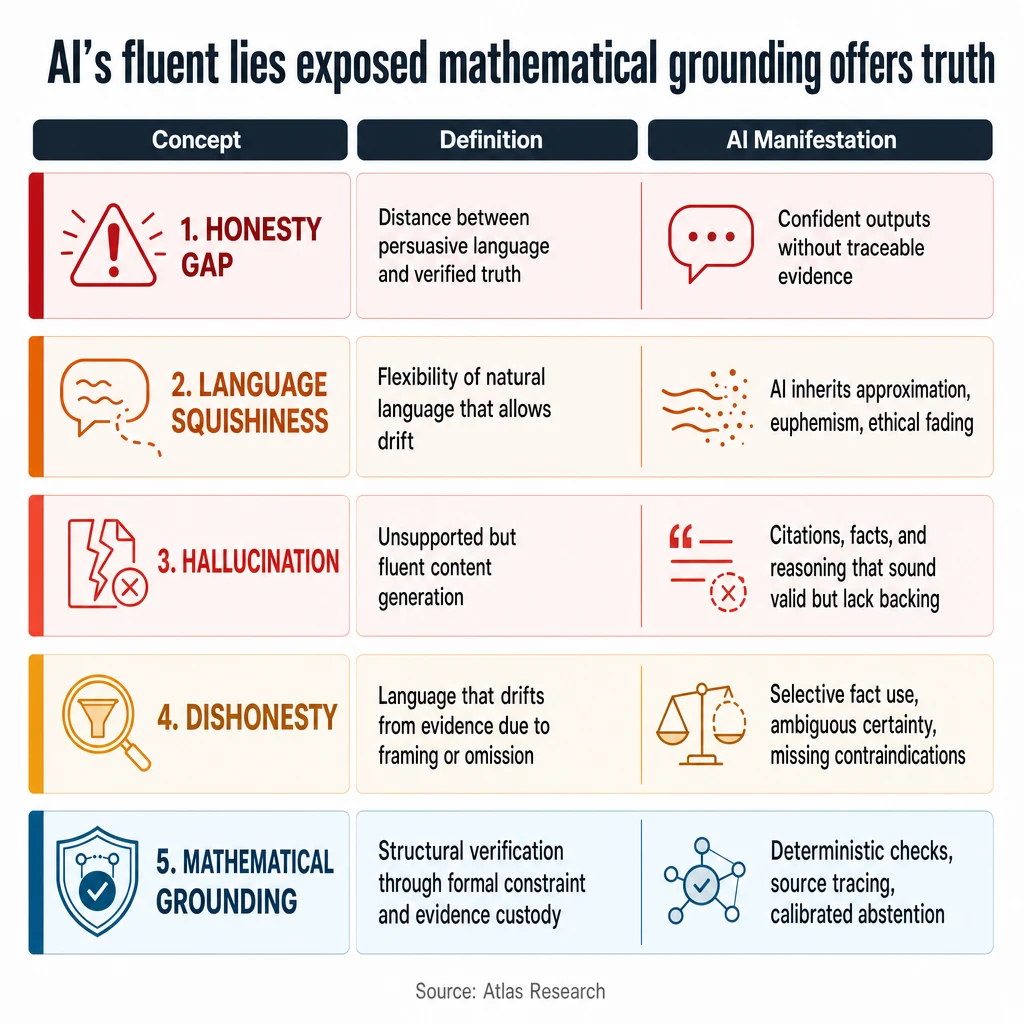
| Concept | Definition | AI Manifestation |
|---|---|---|
| Honesty Gap | Distance between persuasive language and verified truth | Confident outputs without traceable evidence |
| Language Squishiness | Flexibility of natural language that allows drift | AI inherits approximation, euphemism, ethical fading |
| Hallucination | Unsupported but fluent content generation | Citations, facts, and reasoning that sound valid but lack backing |
| Dishonesty | Language that drifts from evidence due to framing or omission | Selective fact use, ambiguous certainty, missing contraindications |
| Mathematical Grounding | Structural verification through formal constraint and evidence custody | Deterministic checks, source tracing, calibrated abstention |
Frequently Asked Questions
What is the honesty gap in AI?
The honesty gap is the structural distance between what AI language models can fluently assert and what they can actually verify as true. It is not simply inaccuracy it is the gap between linguistic confidence and evidence grounding. The concept was formalized by Daryl Ledyard and Philip Tyler, D.M., in a 2026 research paper that examines how language drift in AI systems parallels patterns observed in human cognition.
Why do AI systems struggle with honesty?
AI systems struggle because language itself is squishy flexible by design, optimized for communication and persuasion rather than verification. Language allows approximation, implication, and ambiguity, which are features for human use but weaknesses for machine-grade certainty. When AI systems generate text, they inherit these properties from the human-generated training data. Additionally, language model training optimizes for fluency and coherence, not for verified correspondence with evidence.
What is the difference between AI hallucination and dishonesty?
Hallucination refers to generated content that is not supported by the training data or retrieval sources but sounds confident and well-formed it is often unintentional, a generation artifact. Dishonesty in AI is closer to the human dynamic of motivated reasoning: language that drifts from evidence because of implicit pressures, framing choices, or selective omission. Both are problems, but they require different remediation approaches. Hallucination can be addressed through retrieval augmentation and fact-checking layers. Dishonesty requires structural constraints on how language is generated and evaluated.
How can organizations bridge the AI honesty gap?
Organizations can address the honesty gap by treating verification infrastructure as a core capability rather than an optional add-on. This includes establishing domain-specific truth conditions, implementing source custody protocols so every claim can cite its evidence, calibrating abstention thresholds for high-stakes decisions, and building evidence memory systems that maintain persistent, queryable records of what the system has verified and what remains uncertain. Mathematical grounding deterministic checks, formal verification, and calibrated abstention provides the structural framework.
Is complete honesty in AI systems achievable?
The GenXis Research framework suggests that complete honesty defined as verified correspondence between outputs and evidence requires mathematical grounding as a structural condition, not just a training objective. Perfect systems may not be achievable, but the gap between fluent language and verified truth can be significantly narrowed through deterministic verification, source custody, calibrated abstention, and evidence memory. The goal is not perfection but verifiable grounding: knowing what the system knows, what it can be held to, and when it should decline to answer.