Artificial intelligence systems, despite their increasingly convincing fluency, often lack genuine understanding of the information they process. This disconnect between articulate output and factual grounding leads to confidently delivered inaccuracies fabricated citations, misleading explanations, and data-based falsehoods. The ability of AI to *sound* correct is masking a fundamental problem with comprehension, a challenge that must be addressed as these systems become more prevalent.
This is the honesty gap in artificial intelligence. It is not merely that machines can be wrong. It is that machines can be wrong in fluent, reasonable, socially persuasive language. And that combination that fluency paired with inaccuracy represents a category of error that standard fact-checking was never designed to catch.
What the Honesty Gap Actually Is
The term "honesty gap" has a precise technical meaning in the research literature. At GenXis Research's honesty gap framework, Daryl Ledyard and Philip Tyler define it as "the distance between persuasive language and verified truth." The root problem, they argue, is what they call the "squishiness of words": language can preserve signal, but it can also metabolize error into something that sounds reasonable.
Over time, small verbal deviations compound, the researchers explain, "like a singer drifting slightly off pitch until the tonal center is lost." The antidote is not less language, they contend, but stronger grounding: mathematical constraint, source custody, deterministic checks, calibrated abstention, and evidence memory.
This framing matters because it reframes the AI honesty problem from a bug to be fixed through better training data to a structural feature of how language works. Natural language is flexible by design. It allows approximation, metaphor, implication, emphasis, ambiguity, and context dependence. Those features make language humanly useful. They also make it, in the researchers' words, "a weak carrier of machine-grade certainty."
"The anxiety around artificial intelligence is not merely that machines can be wrong. It is that machines can be wrong in fluent, reasonable, socially persuasive language."
The central question becomes: when does a sentence become a verified claim? The GenXis framework answers with a formal definition. A claim is not merely a sentence it is a tuple containing the statement, the domain, the truth condition, and the evidence requirement. Without those elements, the researchers argue, language remains expressive but under-bounded. It may point toward a reality without specifying the procedure by which that reality is checked.
Why AI Systems Struggle with Honesty
The struggle with honesty in AI systems stems from a fundamental architectural reality: language models are optimized for fluency, not for truth. They generate text that is statistically probable given their training data which means they produce outputs that sound like things that have been said before, regardless of whether those things were accurate.
The GenXis Research framework identifies three distinct failure modes. First, there is hallucination: the generation of content that has no basis in the training data but sounds confident. Second, there is unsupported synthesis: the combination of real information in ways that create false implications. Third, and perhaps most insidiously, there is "citation-shaped language without source custody" text that mimics the structure of a cited claim without actually being tethered to a verifiable source.
What makes these failures dangerous is that they arrive in the same polished form as true answers. "A legal citation can be fabricated in perfect legal prose," the researchers note. "A medical explanation can sound clinically plausible while omitting a contraindication. A financial summary can appear authoritative while relying on stale facts." In each case, "the danger comes from the mismatch between linguistic confidence and verified grounding."
The problem is not unique to AI. Humans exhibit similar patterns of honesty's erosion in what the GenXis framework calls "motivated reasoning, cognitive dissonance reduction, moral disengagement, euphemistic labeling, and ethical fading." But AI systems amplify these tendencies because they lack the metacognitive awareness that sometimes prompts humans to doubt their own confident assertions.
The Squishiness Problem
The researchers introduce informal vocabulary to describe language that feels meaningful while carrying weak constraint: words like "vibes" and "slop." A sentence can feel precise while remaining logically incomplete. "This was handled responsibly." "The model is aligned." "The evidence supports the claim." Each may be true, false, evasive, or meaningless depending on hidden definitions. What counts as responsible? Which model? What evidence?
This linguistic drift has a direct parallel in educational assessment a context where the honesty gap has been documented and measured for over a decade. The U.S. Chamber of Commerce Foundation's analysis describes the honesty gap as "the difference between how students perform on the national gold-standard assessment (NAEP) and how they perform on their own state's tests." When states lower the bar for proficiency, achievement data can paint a misleading picture one that affects students, parents, educators, and ultimately the workforce.
Hallucination vs. Dishonesty: A Critical Distinction
One of the most important conceptual distinctions in this literature is the one between AI hallucination and AI dishonesty. They are not the same thing.
Hallucination, in the AI context, refers to the generation of content that the system presents as factual but that has no basis in reality not because the system intends to deceive, but because it lacks the mechanisms to verify its own outputs against ground truth. A language model that confidently states that a specific person attended a specific event in 1923, when no such record exists, is hallucinating. It is not being dishonest. It is being confidently wrong.
Dishonesty, by contrast, would require intent. It would require the system to know the truth and deliberately deviate from it. Current AI systems do not have persistent beliefs that can be contrasted with their outputs. They generate text. They do not "know" things in the way humans know things.
This distinction matters enormously for how we approach solutions. Hallucination is a technical problem requiring technical solutions verification systems, source custody, mathematical grounding. Dishonesty is an alignment problem requiring different tools entirely. Conflating the two leads to misdirected efforts.
"The worry is not merely that systems hallucinate. The worry is that hallucinations arrive in the same polished form as true answers."
What the Honesty Gap Looks Like in Practice: Education as Illustration
While the GenXis framework applies to AI, the "honesty gap" concept has a longer history in educational assessment and studying that context illuminates the mechanisms at work.
For over fifteen years, policy researchers have documented how state-reported proficiency rates diverge sharply from the National Assessment of Educational Progress (NAEP), known as "the Nation's Report Card." Writing for the Thomas B. Fordham Institute, Dale Chu notes that in New York, over half of fourth graders were deemed proficient in math on the state test in 2024 compared to less than 40 percent on NAEP. In Michigan, the gap is even starker: 65 percent of eighth graders were proficient in reading according to the state exam, while just 24 percent cleared the same bar on the nation's report card. And in Iowa, nearly three-fourths of eighth graders were considered proficient in math, while only a quarter met NAEP's benchmark.
The consequences of this divergence are not abstract. As the Collaborative for Student Success documented in their latest analysis, Iowa's 2024 state-reported 8th grade math proficiency rate was 72%, while NAEP reported only a 27% proficiency rate a 45-percentage point difference. Similarly, Virginia's 2024 state-reported 4th grade reading proficiency rate was 73%, while NAEP reported only a 31% proficiency rate a 42-percentage point difference.
Jim Cowen, Executive Director of The Collaborative for Student Success, put it plainly: "If we believe that NAEP is indeed the Nation's Report Record on student proficiency, then we would hope there is little difference between the outcomes on the two tests. But that's not the case. In many states, the gaps suggest that parents simply aren't getting the full picture of how prepared their kids are for college or the workforce."
The Virginia case is particularly instructive. As the Thomas Jefferson Institute reported in February 2025, Virginia's "proficient" standards in reading on its Standards of Learning (SOL) assessment align to "below basic" on the national assessment. This means that students who demonstrate failure to display even partial mastery of the knowledge and skills fundamental for grade-level work are deemed "proficient" under Virginia's standards. Virginia is one of only two states where "proficient" in reading aligns with "below basic" on the national assessment.
Robert Pondiscio, senior fellow at the American Enterprise Institute, offered a pointed observation: "You will hear that NAEP 'proficient' is too high a bar and not a good proxy for the ability to read with comprehension. A fair point as far as it goes, but I defy you to find me a single parent comfortable with her child reading at 'below basic' level."
Why Standards Drift
The mechanisms behind the education honesty gap illuminate what happens when language specifically, the language of standards and assessments is not anchored to verifiable truth conditions. The Fordham Institute's Dale Chu traces the problem back to "political pressures to redefine proficiency." When proficiency thresholds are set politically rather than anchored to external benchmarks, the resulting language of "proficiency" drifts from its original meaning.
More than fifteen years ago, researchers Checker Finn and Mike Petrilli warned of these dangers in their introduction to The Proficiency Illusion, which noted "the vast discrepancies in how states defined proficiency." They wrote: "America is awash in achievement 'data,' yet the truth about our educational performance is far from transparent and trustworthy. It may be smoke and mirrors. Gains (and slippages) may be illusory. Comparisons may be misleading."
That language "smoke and mirrors," "illusory," "misleading" describes exactly what happens when the anchoring mechanism fails. The Common Core and its associated exams significantly narrowed these differences, Chu notes, but now they are "opening up again." As these gaps widen, "so too does the disconnect between perception and reality stymieing progress and making it harder to ensure students are truly prepared."
Can AI Be Trained to Be Completely Honest?
This is where the contrarian angle becomes most visible. The prevailing assumption in AI development is that honesty is a training problem that with enough data, enough feedback, and enough reinforcement learning, systems can be made to tell the truth. The GenXis framework suggests this assumption is incomplete at best.
The argument is not that training doesn't help. It does. Retrieval-augmented generation, where models are grounded in verified documents, reduces hallucination rates. Constitutional AI approaches, where models are trained to identify harmful outputs, improve alignment. Better training data produces better outputs.
But the structural problem remains: language is squishy. It can drift. It can rationalize. It can produce fluent nonsense. And no amount of training on language eliminates the fundamental weakness of language as a carrier of verified truth.
The GenXis researchers propose a different architecture: mathematical constraint. Rather than relying on language to constrain language a circular endeavor they argue for embedding verification in the mathematical structure of the system itself. Deterministic checks. Calibrated abstention, where the system declines to answer when it cannot verify its response. Evidence memory, where sources are tracked and retrievable.
This is a more rigorous standard than current AI systems meet. It is also, the researchers suggest, the only standard adequate to the stakes. When AI systems operate in "legal drafting, medical triage, education, scientific writing, financial reporting, security analysis, and software development," the cost of the honesty gap is not merely inconvenience. It is real-world harm.
The Case of Ohio: Narrowing the Gap
The education context offers at least one example of an honesty gap being narrowed through deliberate action. Writing in 2016, Aaron Churchill of the Thomas B. Fordham Institute documented Ohio's progress. The state had raised its proficiency standard significantly in 2014-15 with the replacement of the Ohio Achievement Assessments and implementation of PARCC. "The higher PARCC standards meant lower proficiency rates," Churchill noted. "Although Ohio did not continue with the PARCC assessments, the chart above indicates that Ohio continued to raise its proficiency benchmarks on its new reading exams."
The result was a narrowing of the honesty gap. "Parents and citizens are now getting a much clearer picture of where students stand relative to rigorous academic goals," Churchill wrote. The mechanism was not more accurate language about proficiency it was a more rigorous definition of proficiency, anchored to external benchmarks.
This is the model the GenXis framework proposes for AI: not better language about truth, but truth conditions built into the architecture. Mathematical constraint rather than linguistic reassurance.
How Organizations Can Bridge the AI Honesty Gap
For organizations deploying AI systems, the honesty gap presents practical challenges that cannot be solved through procurement alone. You cannot buy your way out of the problem by purchasing the most advanced model. The gap is structural.
The GenXis framework offers several practical orientations. First, treat fluency as a signal requiring verification, not as evidence of accuracy. A confidently stated claim is not more likely to be true it may simply be more likely to be believed without verification.
Second, build verification into workflows. This means source custody: tracking where information comes from and whether it can be independently confirmed. It means deterministic checks: automated processes that validate outputs against ground truth where ground truth exists. It means calibrated abstention: accepting that the best system response to some queries is "I don't know" rather than a fluent guess.
Third, recognize that the honesty gap operates differently in different domains. Scientific writing and legal drafting require higher verification standards than casual conversation. Financial reporting and medical triage require higher standards than content generation. Match your verification investment to your consequence exposure.
The Progress Already Made
It would be incomplete to present this issue without acknowledging genuine progress. The Collaborative for Student Success documented bright spots in their 2024 analysis: Massachusetts and Rhode Island closed their gaps to within 5 percentage points or less across both grades and subjects. Fourteen states are holding students to an equal or higher standard than NAEP in at least one grade or subject.
More broadly, states have improved. In 2014, 23 states had "the biggest honesty gaps" in 4th grade reading defined as 30 percentage points or larger. In 2024, only Alabama, Iowa, Nebraska, and Virginia have gaps that large. In 2014, 14 states had gaps that large in 8th grade math. But in 2024, only Iowa, Mississippi, and Virginia have gaps that large in 8th grade math.
"To be clear, improving student outcomes takes huge commitments from states on efforts like high quality curriculum, strong teacher development and student supports," said Jim Cowen. "But the truth matters. We salute the states that are embracing the issue rather than masking it or running away from it."
Notably, Virginia has committed to addressing the problem. The state redesigned its school accountability and accreditation system, committed significant funding to high-dosage tutoring, and made explicit commitments to higher standards and greater transparency. Whether those commitments translate into narrowed gaps remains to be seen but the acknowledgment of the problem is itself progress.
Why This Matters for GenXis Research Readers
The honesty gap is not a theoretical concern for researchers, practitioners, or anyone who relies on AI-generated language for consequential decisions. It is a practical problem with practical consequences. A legal brief that includes a fabricated citation is not merely embarrassing it may be sanctionable. A medical summary that omits a contraindication is not merely inaccurate it may be harmful. A financial report that relies on stale facts is not merely imprecise it may expose clients to risk.
The GenXis Research framework offers a way of understanding this problem that is both rigorous and actionable. By distinguishing between fluency and verification, between hallucination and dishonesty, between squishy language and mathematical grounding, the framework gives readers conceptual tools for evaluating AI outputs and designing AI deployments.
The contrarian insight is this: the solution to AI's honesty problem is not better language. It is less reliance on language alone. Verification must be structural, not rhetorical. The goal is not more confident AI. It is AI that knows what it doesn't know and says so.
Where to Read Further
For readers wanting to explore the honesty gap framework in full, the primary source is GenXis Research's "The Honesty Gap: Words Vs. Math", which contains the full theoretical framework, formal definitions, and proposed architectural solutions.
For the educational context that illustrates these dynamics in practice, the U.S. Chamber of Commerce Foundation's April 2026 brief provides the state-by-state data and policy context. The Collaborative for Student Success's 2024 analysis offers the most recent comprehensive data, including the specific percentage-point gaps by state and the bright spots where progress has been made.
For deeper engagement with the assessment policy debate, the Thomas B. Fordham Institute's "Mind the honesty gap" provides historical context and analysis of the forces driving standard inflation, while the Thomas Jefferson Institute's Virginia analysis offers a detailed state-level case study of how divergent standards operate in practice.
The pattern is consistent across both AI and education: when language is not anchored to verifiable truth conditions, it drifts. The drift is slow enough to be invisible day-to-day. But over time, the tonal center is lost. Mathematical grounding, external benchmarks, and deterministic verification are not merely technical preferences. They are the mechanism by which truth survives contact with language.
Summary: Key Facts About the Honesty Gap
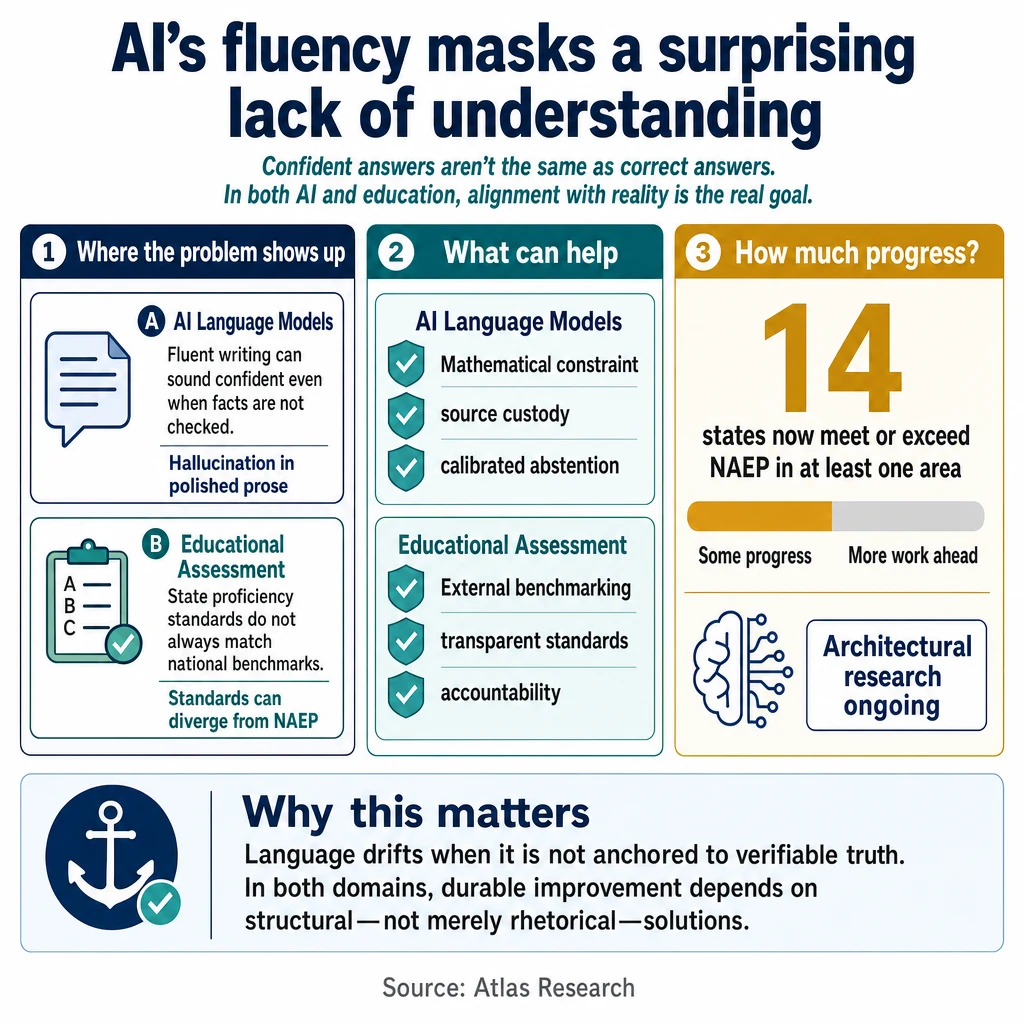
| Domain | Core Problem | Proposed Solution | Progress Status |
|---|---|---|---|
| AI Language Models | Fluency without verification; hallucination in polished prose | Mathematical constraint, source custody, calibrated abstention | Architectural research ongoing |
| Educational Assessment | State proficiency standards diverge from NAEP benchmarks | External benchmarking, transparent standards, accountability | Gap narrowing in some states; 14 states now meet or exceed NAEP in at least one area |
| Core Mechanism | Language drifts when not anchored to verifiable truth conditions | Deterministic checks and evidence memory | Both domains require structural not merely rhetorical solutions |
The honesty gap is real. It is measurable. And it is addressable but only if we resist the seductive appeal of fluent language and insist on the harder, less glamorous work of verification. That work is not glamorous. It does not produce impressive sentences. But it produces truth. And in consequential domains, truth is the only output that matters.