


The Morning Two Proofs Appeared
On the morning of September 8, 2026, two groups of researchers posted results on the same question whether certain equations governing fluid motion can break down in finite time and published machine-verifiable certificates alongside their papers. The overlap was not coincidence. It set off a priority dispute that continues to shape how the field understands what artificial intelligence can contribute to deep mathematics.
OpenAI had spent roughly 10,000 AI agents working for 88 hours to construct an analytical proof and Lean 4 formalization for a forced three-dimensional Navier-Stokes singularity. The company released its findings publicly that morning, linking to an analytical paper and a formal repository. According to its own announcement, the internal system was more capable than GPT-6 Astra and produced results that it said resolved two counterexample options in the official Millennium Prize formulation. The work was accompanied by a Lean 4 certificate an executable artifact that a proof assistant could independently check.
Roughly seven hours earlier, Tristan Buckmaster of NYU's Courant Institute and Levent Alpöge, a mathematician employed by Anthropic, had posted three papers and their own Lean 4 formalization. Their results covered finite-time blowup with smooth forcing for the incompressible porous media equation, the planar Boussinesq system, and the three-dimensional incompressible Euler equations. The two announcements were not the same result. The distinctions between them carry the weight of the entire episode.
Stanford Tech Review later cloned and measured both formal repositories. Together they contained 2.3 million lines of Lean code, zero extra axioms, and no development history on either side. The machine-readable artifacts were there. The question of what they proved and for whom was just beginning.
What Lean Actually Checks
The Lean component of OpenAI's release deserves careful attention because it changes the nature of the uncertainty. Lean 4 is an interactive theorem prover that checks whether a formal proof follows from declared definitions, theorems, and axioms. Its presence creates an independently executable object instead of another long AI-generated manuscript. That distinction matters as OpenAI, Anthropic, Google, and academic researchers push AI systems toward harder mathematics.
According to an analysis published by the DiscoverAI editorial team, a proof assistant establishes that encoded conclusions follow from encoded definitions, assumptions, and accepted dependencies. That can substantially reduce certain classes of reasoning error. It does not automatically tell a general reader whether the theorem has the exact scope suggested by a headline. A responsible reproduction record should identify repository commit, toolchain version, and dependencies and the community still needs to assess whether the formal statement matches the intended mathematical problem.
Three separate verification questions remain distinct, as the DiscoverAI guide outlines: Did a company release a claim? Does the formal argument check? Does it settle the intended problem? A positive answer to the first question does not answer the other two. Even a successful formal build needs an assessment of whether the formal statement matches the intended mathematical problem.
The Translation Problem Nobody Has Solved
On October 6, 2026, researchers at King's College London and the University of Cambridge published a paper with a pointed title: Navier-Stokes lost in translation: Why Lean verification of AI autoformalisation does not guarantee correct natural language proofs. The authors Alexander Bastounis, Fabian Circelli, and Anders C. Hansen had examined OpenAI's release and found specific mismatches between what the natural language paper declared and what the Lean formalization actually proved.
The core problem they identified is not unique to OpenAI. Autoformalization the process of translating a mathematical argument from natural language into a formal language such as Lean has become a standard tool for verifying AI-generated proofs. The promise is seductive: once the translation is complete, the formal argument can be mechanically checked. But Bastounis and his coauthors argue that this process may offer no confidence in the original natural language argument, owing to the difficulties of performing the translation semantically faithfully.
In particular, they demonstrate that the formalised Lean proof does not correspond to the natural language proof of blow-up of solutions to the Navier-Stokes equations. The mistranslations fall into several categories. In some cases, the natural language paper declares stronger statements than what Lean proves. In others, both the statement and its proof are mistranslated together, so the Lean proof validates something that is not what the natural language paper claims. The authors provide several concrete examples drawn from OpenAI's own release.
The root cause, they argue, is that resolving ambiguities in mathematical natural language text which is necessary for semantically faithful translation sits arbitrarily high in the Solvability Complexity Index hierarchy. Informally, providing semantically faithful AI autoformalization is harder than any computational problem, including the Halting problem. The SCI equals infinity. That is not a engineering limitation awaiting better models. It is a structural feature of the translation task itself.
Scope and What the Prize Actually Asks
The Clay Mathematics Institute's Navier-Stokes existence and smoothness problem carries an official formulation with multiple alternatives. OpenAI's result addresses options (C) and (D) rather than the celebrated (A)/(B) regularity question that sits at the heart of the Millennium Prize's most famous formulation. The company states plainly that it does not intend to claim the Millennium Prize for the result.
This matters because the four results published on September 8 are not the same result. Buckmaster and Alpöge proved blowup for forced Euler a smooth external force is applied, and the fluid's vorticity becomes unbounded in finite time. OpenAI's Euler result is the unforced case, which is harder in the sense that the singularity must arise from the fluid's own motion without external assistance. OpenAI's Navier-Stokes result reinstates viscosity and a smooth force, which is the route through options (C) and (D) rather than the regularity question that has drawn the most sustained attention from mathematicians over the past two decades.
The scope question connects directly to what the Lean certificate can and cannot establish. The proof assistant checks that encoded conclusions follow from encoded definitions. It cannot independently determine whether the theorem statement, as encoded, matches what the Clay Mathematics Institute's official formulation intends. That requires human expert review of the mathematical substance, the problem scope, and the relationship between the result and existing literature.
The Priority Dispute in Brief
The September 8 announcements arrived in a context shaped by a week of rumor. OpenAI's own post says its effort began on September 1, 2026, after it heard that two Millennium problems had been resolved the same rumor cycle that produced a viral prediction that Claude had solved Navier-Stokes. The timing is not incidental.
Buckmaster's statement, released the same morning as OpenAI's announcement, alleges that OpenAI began its effort only after learning about his and Alpöge's work, and describes calls in which he says he was pressured to reframe the credit. OpenAI's post says its researchers and agents did not see any of their work before publication. Buckmaster's announcement on Mastodon, posted at 03:58 UTC, was three sentences and five links. It described three results, noted that one half of the story was checkable that day and the other was not, and went on to become the opening move in a public dispute that has continued through the autumn.
Both groups shipped machine-verifiable Lean certificates. Stanford Tech Review's audit found no extra axioms and no development history on either side. The formal artifacts are inspectable. What they prove, what they mean, and who deserves credit for what are separate questions that require human judgment, expert attribution, and the passage of time.
Why This Matters for AI and Mathematics
The OpenAI release represents a new kind of mathematical artifact. It is not simply a paper posted to a preprint server. It is a paper accompanied by an executable formal proof that the broader community can run, inspect, and verify using open-source tools. That is genuinely new territory, and it changes what is possible for independent review.
The tension is not simply model versus model. It is machine-checkable verification versus scientific trust built through expert interpretation, attribution, and time. A successful Lean build establishes that the formal argument is internally consistent. It does not establish that the formal argument corresponds to the natural language argument, that the theorem statement matches the intended problem, or that the result has received the kind of expert scrutiny required for broad mathematical acceptance.
The paper by Bastounis, Circelli, and Hansen makes a contribution that extends beyond this specific case. It demonstrates, with concrete examples, that the translation problem in AI autoformalization is not merely a matter of improving model quality or adding more training data. The difficulty is structural. Resolving ambiguities in mathematical natural language sits at a level of complexity that exceeds the Halting problem. No algorithm including whatever system OpenAI used to generate its proof can reliably solve it.
This does not mean AI autoformalization is useless. It means that the confidence it provides is different from what many headlines suggest. A machine-checked certificate tells you that the formal proof is consistent. It does not tell you that the formal proof is semantically equivalent to the natural language argument you started with. Understanding that gap requires the same kind of expert human review that mathematics has always required.
What the Code Actually Contains
Stanford Tech Review's technical audit provides one of the most concrete windows into what the Lean formalizations contain. The reviewers cloned both repositories and measured their contents. What they found was a combined body of 2.3 million lines of Lean code, zero extra axioms across both projects, and no development history on either side. The absence of development history means there is no visible paper trail showing how the proofs evolved, what assumptions were changed, or what errors were corrected during development.
The formal artifacts are clean by the standards of proof assistants. They compile without errors and they verify without invoking additional axioms beyond Lean's standard library. But cleanliness in this sense is a necessary condition, not a sufficient one. It tells you the proof is internally consistent. It does not tell you the proof is complete, that it covers the intended scope, or that it was not produced through a chain of mistranslations that happened to land on a consistent formal structure that does not correspond to what the natural language paper claims.
The Bastounis paper provides specific examples of exactly this phenomenon. In one category of mistranslation, the natural language paper declares a stronger statement than what the Lean proof actually establishes. In another, both the statement and the proof are mistranslated in coordinated ways, so the Lean proof verifies something that is not what the natural language paper claims to have proved. These are not rare edge cases. They are examples drawn directly from OpenAI's release, documented in a peer-reviewed paper published on October 6, 2026.
The Emerging Contest Over Mathematical Trust
The episode reveals something about how mathematical trust is built and why it resists automation. The conventional publication and community-review process preprint, peer review, replication, extension, synthesis exists not because mathematicians distrust each other but because deep mathematical results require sustained human interpretation to establish what they mean, how they relate to existing work, and whether they are correct.
OpenAI's release has not completed that process. The company published its claim on September 8, 2026. The Bastounis paper appeared on October 6, 2026, raising specific concerns about mistranslation. The Clay Mathematics Institute has not awarded any prize. Independent experts have not reached consensus. The formal artifacts are available for inspection. The natural language paper is available for review. The question of whether the result settles what it claims to settle and for whom remains open.
This is not a story about a failed proof or a dishonest claim. It is a story about the gap between a machine-checked certificate and a fully verified claim, and why that gap persists even when the certificate is genuine and the proof assistant does its job correctly. The Lean build verifies that the formal argument is consistent. The human review process establishes what the result means, how it relates to the intended problem, and whether it deserves the label "solved."
That process takes time. It takes experts who are willing to read carefully, check assumptions, and publish findings. It takes the kind of trust that accumulates through sustained engagement with a result over months and years. No Lean certificate can shortcut it. No announcement on a September morning can complete it.
What This Means for OpenAI Readers
If you are following this story because you are interested in what AI can contribute to frontier mathematics, the OpenAI release offers a useful case study in what machine-checkable artifacts can and cannot do. The Lean formalization is a real artifact that anyone can run and verify. It demonstrates that AI systems can produce formally consistent mathematical arguments at a scale and speed that was not possible before. That is genuinely new.
But the release also demonstrates the limits of formal verification as a stand-alone tool for establishing mathematical truth. The gap between the formal certificate and the verified claim requires human expertise, careful reading, and time. Understanding that gap and knowing what questions to ask about any AI-generated mathematical result is a skill that will matter more as these systems become more capable and their outputs become more complex.
The Clay Mathematics Institute's official formulation remains the essential reference for interpreting what any Navier-Stokes result does or does not settle. The Bastounis paper offers a peer-reviewed analysis of what the translation problem means for autoformalization broadly. Stanford Tech Review's audit provides the most concrete technical comparison of the two Lean repositories published on September 8. These are the primary sources worth reading directly if you want to understand what the artifacts actually contain.
Where to Read Further
The primary artifacts are worth examining directly. OpenAI's announcement, published September 8, 2026, links to both the analytical paper and the formal repository. The Buckmaster-Alpöge papers and their Lean formalization are available through the same channels. Stanford Tech Review's audit at OpenAI vs Buckmaster: The Navier-Stokes Lean Proofs, Audited provides the most thorough technical comparison of what both sides published.
For understanding the translation problem in AI autoformalization specifically, the paper by Alexander Bastounis, Fabian Circelli, and Anders C. Hansen Navier-Stokes lost in translation offers peer-reviewed analysis with concrete examples drawn from OpenAI's own release. The DiscoverAI guide on OpenAI's Navier-Stokes Proof Claim: What Is Verified? provides a clear framework for distinguishing between the published claim, the formal checking, and independent mathematical acceptance.
The Wikipedia entry on the Navier-Stokes priority controversy documents the context of the competing announcements and the key figures involved. The official Clay Mathematics Institute formulation remains the essential reference for understanding what the Millennium Prize problem actually asks.
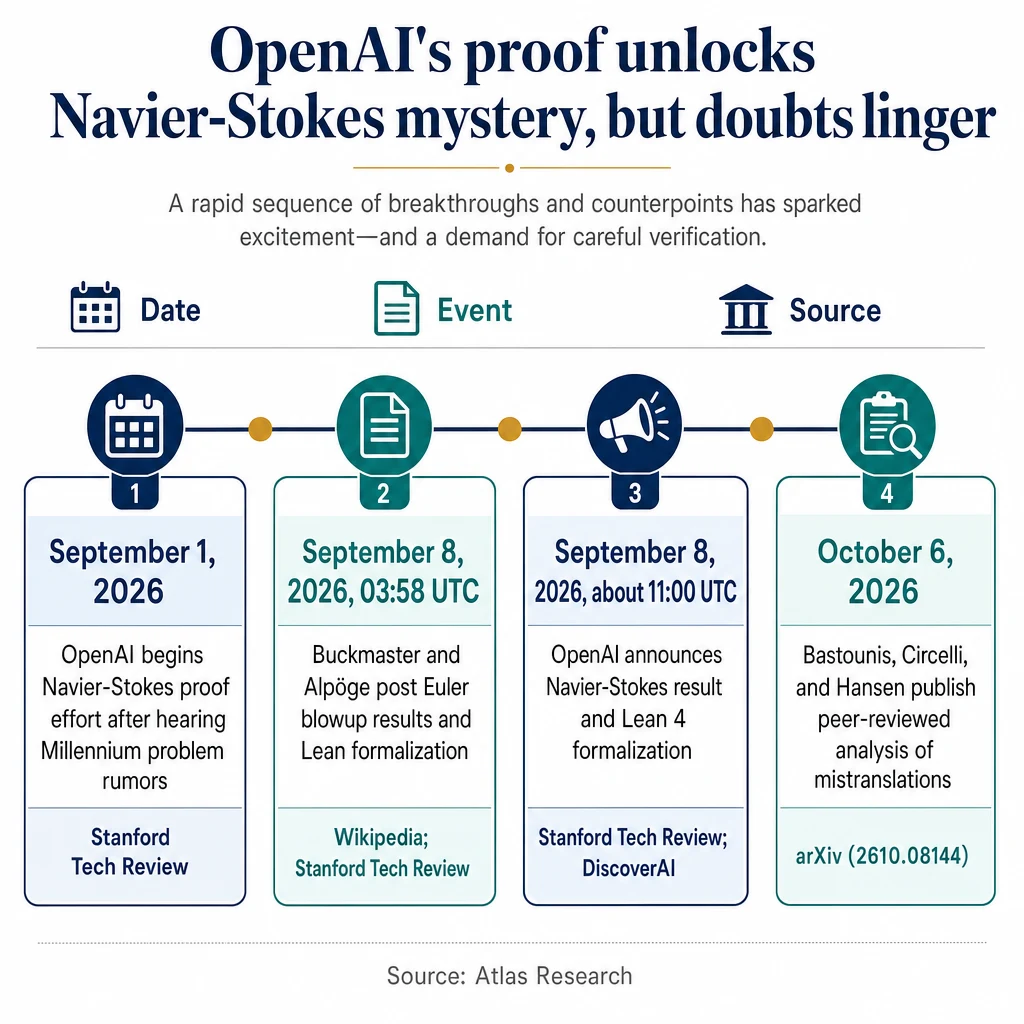
| Date | Event | Source |
|---|---|---|
| September 1, 2026 | OpenAI begins Navier-Stokes proof effort after hearing Millennium problem rumors | Stanford Tech Review |
| September 8, 2026, 03:58 UTC | Buckmaster and Alpöge post Euler blowup results and Lean formalization | Wikipedia; Stanford Tech Review |
| September 8, 2026, ~11:00 UTC | OpenAI announces Navier-Stokes result and Lean 4 formalization | Stanford Tech Review; DiscoverAI |
| October 6, 2026 | Bastounis, Circelli, and Hansen publish peer-reviewed analysis of mistranslations | arXiv (2610.08144) |