The 50 Traps That Expose What AI Coding Models Actually Know
In a fluorescent-lit testing facility that no one outside the team has visited, a language model receives its challenge: a small coding task designed to look correct at first glance but to fail in a specific, reproducible way. The model answers. The answer is recorded, timestamped, and frozen. Then something unusual happens. A second independent check runs the same question. Then a third. Only when two of three agree does the mistake count.
This is the methodology behind Most Annoying AI's verified failure benchmark, and it represents one of the more rigorous attempts to answer a question that has grown urgent for the hundreds of thousands of developers integrating AI coding assistants into their workflows: how do we actually know what these models can and cannot do?
The answer, it turns out, depends entirely on which benchmark you consult and that is precisely the problem.
What SWE-bench Actually Measures
Software Engineering Benchmark, known as SWE-bench, is a collection of real software engineering tasks extracted from GitHub repositories. Each task presents the model with an issue the kind of bug report or feature request a developer might encounter in a real project and asks the model to produce a patch that resolves it. The benchmark then verifies whether the patch actually works by running the model's solution against the same test suite that human developers use.
The key distinction is that SWE-bench tests resolution, not generation. A model might write elegant, syntactically perfect code that looks right but doesn't solve the problem. SWE-bench catches this by executing the patch and checking whether the tests pass.
The benchmark comes in two versions. The original SWE-bench has been criticized for potential data contamination models may have encountered the exact issues during training. SWE-bench Verified attempts to address this by re-running tasks with stricter conditions, removing cases where contamination is suspected, and applying more rigorous evaluation protocols.
According to the SWE-Bench Verified Leaderboard maintained by LLM Stats, the current ranking reflects 113 models tested under these conditions, with Claude Fable 5 from Anthropic leading at a score of 0.950 meaning the model correctly resolved 95 percent of the verified issues presented to it.
The August 2026 Coding Rankings: Who Leads and Why
The landscape of AI coding capability has shifted considerably since the early days of GitHub Copilot and initial GPT-4 deployments. As of August 28, 2026, multiple independent tracking systems paint a picture of a market where Anthropic's Claude family holds significant ground, but competition has intensified dramatically.
BenchLM's coding-specific rankings, updated for August 2026, place Claude Mythos 5 at the top of their coding leaderboard with a score of 81.7. The same platform tracks 406 language models across 408 benchmarks, providing context that a single score tells only part of the story.
The SWE-bench Verified Leaderboard offers a more granular view. Below the Claude Fable 5 lead at 0.950, the rankings reveal a tight cluster of high performers:
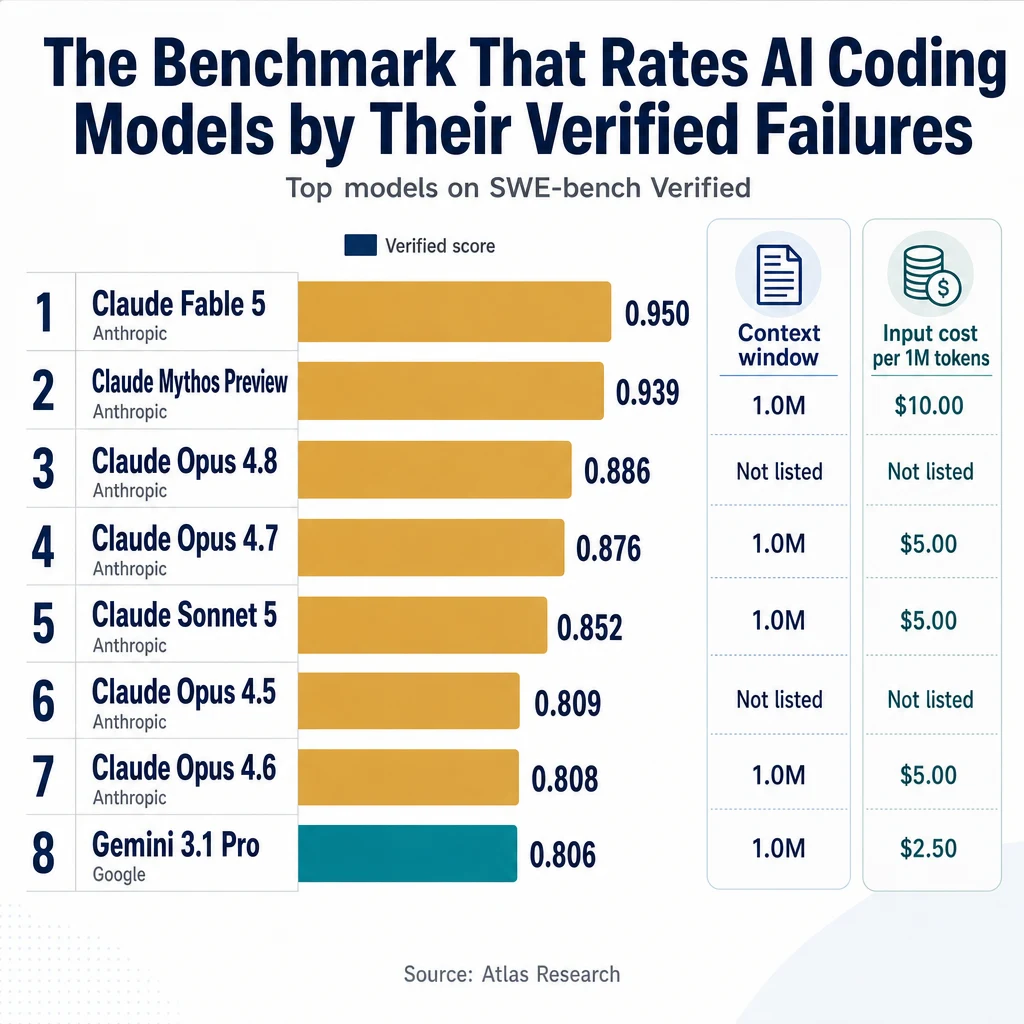
| Rank | Model | Organization | SWE-bench Verified Score | Context Window | Input Cost (per 1M tokens) |
|---|---|---|---|---|---|
| 1 | Claude Fable 5 | Anthropic | 0.950 | 1.0M | $10.00 |
| 2 | Claude Mythos Preview | Anthropic | 0.939 | ||
| 3 | Claude Opus 4.8 | Anthropic | 0.886 | 1.0M | $5.00 |
| 4 | Claude Opus 4.7 | Anthropic | 0.876 | 1.0M | $5.00 |
| 5 | Claude Sonnet 5 | Anthropic | 0.852 | 1.0M | $2.00 |
| 6 | Claude Opus 4.5 | Anthropic | 0.809 | ||
| 7 | Claude Opus 4.6 | Anthropic | 0.808 | 1.0M | $5.00 |
| 8 | Gemini 3.1 Pro | 0.806 | 1.0M | $2.50 | |
| 8 | DeepSeek-V4-Pro-Max | DeepSeek | 0.806 | 1.6T parameters | |
| 10 | MiniMax M3 | MiniMax | 0.805 | 1.0M | $0.30 |
What becomes immediately visible is that the Claude family dominates the upper echelons, holding seven of the top ten positions. However, the rankings also reveal competitive pressure from Chinese AI labs DeepSeek and MiniMax models appear in the top ten alongside Google's Gemini offerings.
The cost column tells a parallel story. Claude Opus 4.8 costs $5.00 per million tokens for output, while MiniMax M3 costs just $0.30 per million tokens for output nearly seventeen times cheaper. For high-volume development teams, this pricing differential creates genuine strategic questions about which model delivers sufficient quality for their specific use cases.
Why Cost-to-Performance Ratios Matter More Than Raw Rankings
When evaluating AI coding models, the temptation is to focus on the highest-scoring model and assume the problem is solved. The reality is more nuanced. According to research compiled by LLM Stats on best AI for coding in 2026, the optimal choice depends heavily on context, budget, and the specific nature of the coding work being performed.
DeepSeek-V4-Pro-0813, for instance, earns recognition as offering "best open-weight quality-to-price in the market" with "frontier-adjacent quality at approximately ten times cheaper than US frontier" models. The trade-off is that routing through PRC providers may raise data-residency concerns for some organizations.
Claude Opus 4.8, by contrast, is noted for "long-form coherence voice and structure stay consistent over thousands of tokens," making it well-suited for complex architectural decisions or documentation-heavy tasks. But its output cost of $5.00 per million tokens makes it "not the default for cost-sensitive workflows."
For teams building internal tools or running high-volume automated processes, the calculus shifts entirely. A model scoring 0.750 on SWE-bench at one-tenth the cost of the leader may represent better value than the top-ranked model for their specific needs.
Beyond SWE-bench: The Case for LiveCodeBench
SWE-bench has a limitation that its creators acknowledge: it tests a model's ability to resolve fixed, historical issues. This means the benchmark may not capture how models perform on the kinds of novel problems that arise in active development. It also means that SWE-bench can become stale once enough models have been trained on the underlying data, the benchmark loses its ability to discriminate between genuinely capable systems and those that have simply memorized solutions.
LiveCodeBench was developed to address this gap. Rather than testing against a fixed dataset, LiveCodeBench continuously generates new coding challenges over time, testing models on problems they could not have encountered during training. This approach offers a more dynamic picture of coding capability, though it introduces its own challenges around standardization and reproducibility.
The relationship between SWE-bench and LiveCodeBench is not hierarchical but complementary. SWE-bench provides a rigorous, reproducible assessment of a specific capability: can this model correctly resolve an issue when given clear requirements and test cases? LiveCodeBench provides a broader, more fluid assessment of general coding competence across time.
For teams making strategic decisions about AI tooling, both benchmarks offer value, but at different stages of evaluation. SWE-bench scores are more useful for predicting performance on bug-fix and patch-generation tasks. LiveCodeBench scores are more useful for predicting general coding assistant utility.
The Dual-Check Methodology: A Different Lens on AI Failure
The most unusual approach to AI coding evaluation comes from Most Annoying AI, whose methodology deserves specific attention because it addresses a concern that traditional benchmarks largely ignore: what happens when a model produces a confidently wrong answer?
According to the Most Annoying AI benchmark documentation, their system works differently from conventional leaderboards in four key respects:
- Frozen tasks: Every model receives the same 50 failure traps small coding tasks designed to expose wrong but plausible answers.
- Recorded answer: The model's recorded reply is the only thing scored, with no edits, retries, or commentary replacement allowed.
- Dual check: A mistake counts only if two independent checks reproduce it.
- Receipt root: Hashes bind the released evidence archive, creating a verifiable audit trail.
This approach focuses explicitly on the "annoying" failures the ones where AI produces code that looks reasonable but contains subtle errors that can take as long to debug as writing the code from scratch. It is a benchmark designed not to measure peak capability but to surface the frustrating edge cases that matter for developer experience.
The GenXis Gavel TM certification process requires that "only complete GenXis Gavel-certified models appear in the ranked chart." Incomplete or withheld evidence stays visible but does not receive a ranking. This represents a philosophical difference from traditional leaderboards: transparency about methodology is treated as a prerequisite for inclusion, not an optional enhancement.
How GPT, Claude, and Gemini Actually Compare
The question of how OpenAI's GPT series, Anthropic's Claude family, and Google's Gemini compare on coding tasks is complicated by the sheer number of variants now available. As of August 2026, the LM Council benchmark comparison tool lists hundreds of specific model configurations across these three families, with varying capability levels, pricing tiers, and context windows.
The comparison matters because the naming conventions across providers are not standardized. A model labeled "GPT-5.2" from OpenAI, "Claude Fable 5" from Anthropic, and "Gemini 3.1 Pro" from Google represent entirely different architectural approaches, training methodologies, and specialization decisions despite the similar numbering.
On SWE-bench Verified, the current standings show Anthropic models leading across most tiers. GPT-5.2 appears at position 15 with a score of 0.800, trailing multiple Claude variants and competing with Google's Gemini 3.1 Pro at 0.806. This represents a notable shift from earlier periods when OpenAI held a clearer lead in coding capabilities.
However, raw benchmark positions understate the complexity of the competitive landscape. Different model families have different strengths:
- Anthropic models demonstrate strong performance on SWE-bench Verified and are noted for long-context coherence and consistent output structure over extended codebases.
- OpenAI models offer deep integration with existing development tools and have established ecosystems through GitHub Copilot and API infrastructure that many teams already use.
- Google models provide competitive pricing and strong performance on Gemini 3 Flash variants, making them attractive for cost-sensitive deployments.
The comparison becomes more complex still when considering that benchmark performance does not always translate directly to developer experience. Factors like API responsiveness, context window management, code editing capabilities, and integration with specific development environments all influence which model actually performs better in a given workflow.
What This Means for Development Teams Evaluating AI Tools
The proliferation of benchmarks and rankings creates a counterintuitive challenge: more data makes decisions harder, not easier. A team evaluating AI coding tools in August 2026 faces not a single authoritative ranking but multiple competing systems, each with different methodological assumptions and different definitions of success.
The practical response is to match benchmark selection to use case. For teams primarily using AI to resolve bugs and generate patches, SWE-bench Verified provides the most directly relevant signal. For teams seeking a general coding assistant for varied tasks, LiveCodeBench offers a broader assessment. For teams concerned about the specific frustrating failures the confidently wrong code that wastes debugging time the Most Annoying AI methodology provides a uniquely useful lens.
Cost remains a significant factor that benchmarks do not always weight appropriately. A model that scores 0.900 on SWE-bench at $0.30 per million output tokens represents better value for many use cases than a model scoring 0.950 at $5.00 per million tokens. The marginal 5 percentage points of capability may not justify the seventeenfold cost increase for routine development tasks.
There is also the question of benchmark reliability. As models become more capable, the risk of data contamination in historical benchmarks increases. SWE-bench Verified attempts to address this, but no benchmark is immune to the possibility that future models will have encountered similar training data. LiveCodeBench's continuous challenge generation offers some protection, but introduces its own standardization challenges.
The Transparency Question: Why Auditability Matters
Beneath the surface of ranking disputes lies a more fundamental question about how AI evaluation should work. Traditional benchmarks publish scores; they rarely publish the evidence. The Most Annoying AI approach of requiring "receipt roots" and publishing audit JSON files represents a different philosophy: evaluation should be auditable, not just accurate.
The distinction matters for several reasons. First, it allows independent verification. Anyone can download the challenge questions, exact prompts, recorded model responses, judge reasons, and receipts and check the work themselves. Second, it creates accountability. A model cannot be ranked without completing the full evaluation process and having its evidence published. Third, it surfaces the methodology itself as something worth examining.
This transparency-oriented approach aligns with the broader movement in AI development toward interpretability and explainability. If developers are expected to trust AI systems with code that will ship to production, they deserve evaluation systems they can examine, not just scores they must accept.
Where the Landscape Goes From Here
The AI coding benchmark landscape is unlikely to stabilize soon. As models grow more capable, existing benchmarks will need to evolve or become obsolete. New evaluation methodologies like the dual-check approach from Most Annoying AI will either gain adoption or fade, depending on whether the community values their specific focus on verifiable failure modes.
The competitive dynamics between providers will continue to shift. Anthropic's current lead on SWE-bench Verified is significant but not insurmountable. OpenAI's deep integration advantages and Google's pricing flexibility represent genuine competitive moats that may matter more than benchmark positions for many teams.
For developers and organizations making tool decisions, the practical takeaway is that benchmark scores should inform but not determine choices. The specific nature of the work being performed, the cost constraints of the organization, and the particular failure modes that matter most for a given project all deserve weight alongside raw performance numbers.
The benchmarks exist to serve decision-making, not to replace it. Understanding what each benchmark measures and what it doesn't may be more valuable than chasing the latest leaderboard position.
Where to Read Further
For the full SWE-bench Verified Leaderboard with detailed scoring methodology and model-specific performance data, visit the official LLM Stats benchmark page, which tracks 113 models with current scores updated through August 2026.
BenchLM offers comprehensive coverage of coding-specific benchmarks alongside broader model comparison tools, with their August 2026 coding rankings providing live data on Claude Mythos 5 and competing models.
For teams interested in the verification methodology behind failure-focused evaluation, the Most Annoying AI benchmark documentation provides detailed explanation of the Gavel TM certification process and dual-check verification system.
The LM Council benchmark comparison tool allows direct head-to-head comparison of GPT, Claude, and Gemini variants across multiple evaluation dimensions.